Sunday, April 24, 2011
Mass Chipa making...as promised
Wednesday is the Chipa day. I went over to my host grandma's house because my mom doesn't have a tatakua(clay dome oven) and made chipa all day long. Thursday I helped Estela (host mom) make Sopa Paraguay for our Cena final (final meal), which was Asado, Sopa Paraguaya, and Mandioca. Then Estela and I drank wine and coke and talked for a while and then I went to a nemboe hape (prayer meeting) because someone in the community had recently died. From Thursday afternoon until Saturday morning no work is supposed to happen...actually until sunday as well. Friday I went back to the same friend's house who gave me Passion Fruit juice and hung out with her family and her sister-in-law's family. She gave me some chipa. Her house is pretty far away and down this huge hill in my community but luckily another friend passed with her family in their newish truck and I hitched a ride up the hill. We drank Terere and she gave me my own back of Chipa.
It seems to be a custom for everyone to give the Norteamericana her own bag of Chipa. I have a huge pile of it in my house now.
Friday afternoon the community met on one edge of the community and we walked house to house praying and reading each station of the cross. It was finished by saying the Apostle's creed at the Prayer Chapel. Saturday, Yesterday, rained all day and I stayed in my house with Ara, my cat, and read, and wrote letters, and did some more unpacking. That was my Semana Santa. I tried to go into Asuncion early this morning for an English Speaking service that I had heard about, but it never happened. It is kind of weird to not have all the Easter traditions that I am used to, but I appreciated walking the stations of the cross on Friday.
So...here are the Chipa pics:
Mi oga'i (my little house)
Another option was renting a room with a family. Most families have children that come from Asuncion to visit every once and a while so renting a room from them was not an option. My last option was to live in a house that the previous volunteer built, but he gave it to the family, who then added onto it and used it for their teenage sons. Lets face it...female introverted American, sharing a space with 15 and 16 year old Paraguayan boys who love motorcycles and loud reggaeton music at all hours of the day (an night), and morning....
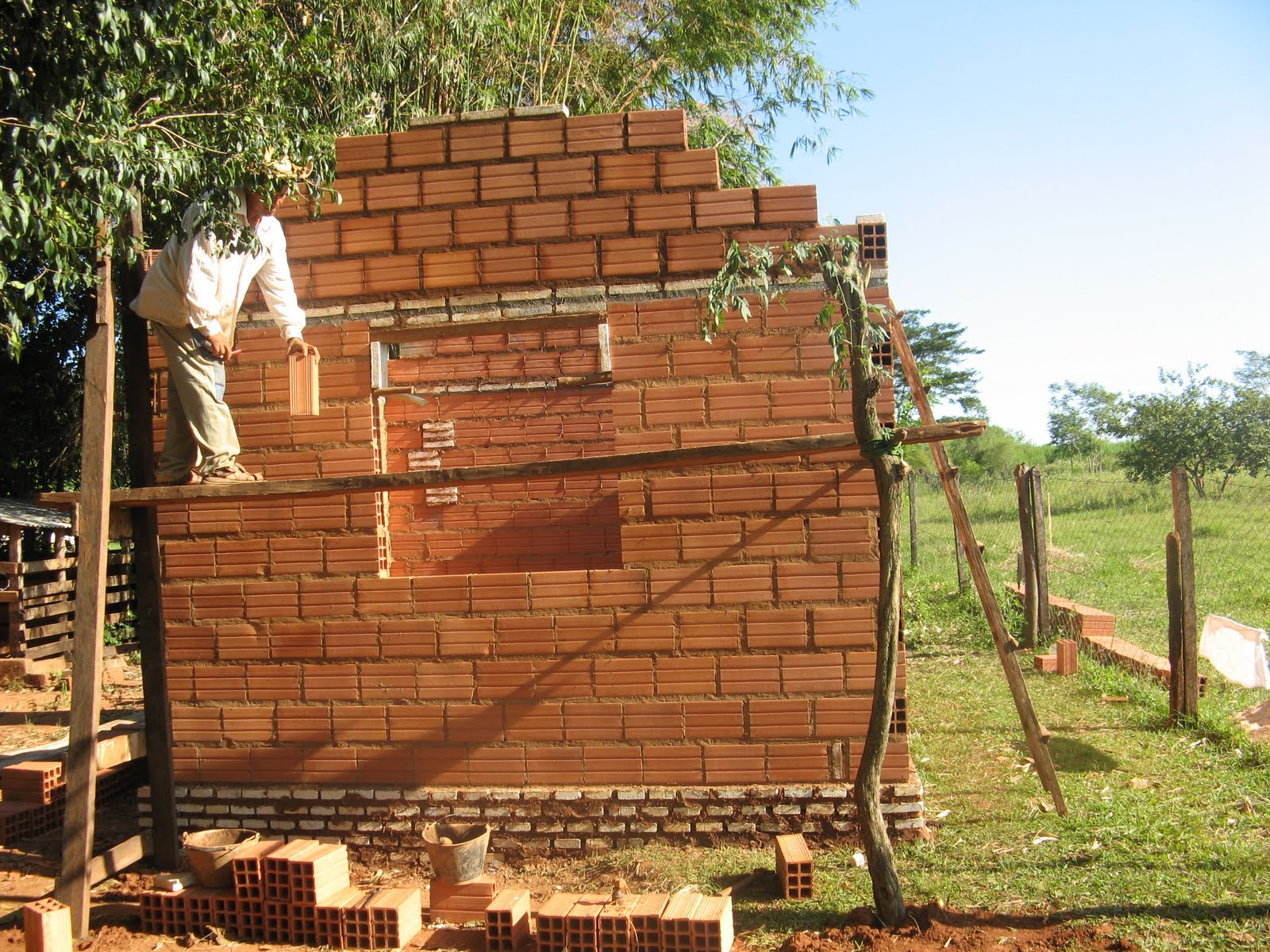
So I decided to build a small room on the property of my community contact. Her husband works construction so he helped design it and we build it together. He recommended using bricks, since wood is expensive and there is not longer straw around for roofs. The house is on the back edge of their property right before the soccer field/cow pasture. After the cow pasture becomes the fields. Don Ramon, my contact's husband, is extremely worried about my safety and since I am so close to the Chacra I am more at risk. I like the location. It is really tranquilo. I don't have to fight with reggaeton as much, and I am off the main road. When neighbors come over, which they do since my contact is an unofficial community leader, I can wave and say hello from my door.
building the foundation.
My materials. Bricks, sand, and more bricks.
building the walls.
Super Guapo (hard-working) Don Ramon Varela building the house up.
Paraguayan equivalent of scaffolding.
Framing the roof. Not the same as in the states.
Sticking my little head through the roof on the day we put on the Tefuelon (an insulation layer on the roof)
Oimpama la oga. (The house is finished!)Tuesday, March 8, 2011
Nuestro Pan de Cada dia

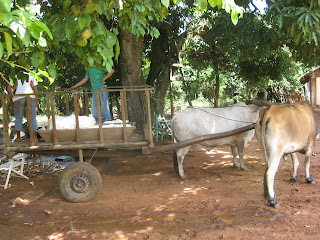
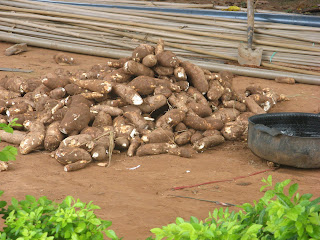
This leaves a pile of mandioca sitting on the lawn that was usually transported on an ox cart.
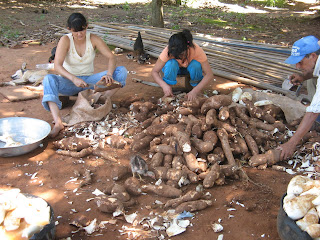
After 5 times of making almidon I think that I am finally getting the hang of peeling mandioca. I first tried to peel it like a potato, but there is actually a thick layer of skin that you need to get off. I am really proud that I have accomplished this.
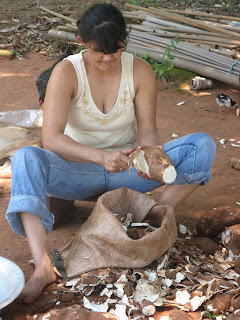
My host mom Estela is really bombin' at this.
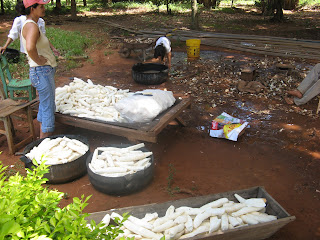
Pretty straight forward: Scrub scrub scrub
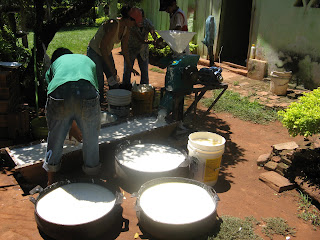
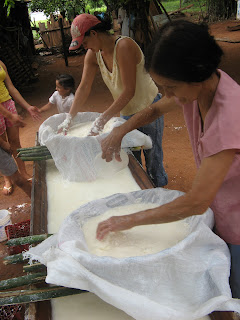
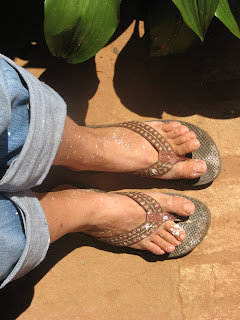
My Feet after a long day of helping the women make Almidon. So I have yet to see this mass making of chipa. More on chipa making to come....
Thursday, February 24, 2011
An Inauguratory Ride
So with the power of the sun piercing our skin we set out on our journey, he on foot, and I on my new bike. It was a release to be able to zip through the Kokue (fields) after 2 months of going everywhere on foot. But the caminoe (path) is not as smooth as it used to be. The grass has been padded down and browned by traffic. The soil is exposed and when it rains the dirt is washed away. The motos and oxen carts beat it down and it has become uneven. I had to stop myself several times so I wouldn't fall. I heard Gustavo running behind me as I struggled over the rough terrain.
We passed the mandioca field and my small demo plot where my corn and beans are growing well. We passed a Senor's field of corn that I had watched go from being disced to my height in a short time. We passed sugar cane that is starting to reach harvestable height. When we reached some trees I decided we needed a rest. I was glad I had filled the water bottle (came new with the bike!) with water.
I climbed back on the bike and we continued. When we reached part of the ride along a barbed wire fence that is cow pasture I decided to walk to prevent falling and cutting myself on the wire! Gustavo, like a good Paraguayan "man" offered to walk the bike. He had told me a couple of days before my bike arrived that he would use it to go to school, so I told him to hop on and try it out. He did, and his short legs barely reached the pedals, and he was sitting on the bar instead of the seat. He continued to ride on the smooth road we had entered. As much as I wished to be the one to initiate my bike, I allowed him to continue. The sun had worn me out and there was no shade on the road, so I made the call to enter into Grandma's house for a rest. She welcomed us in, even though she was bathing her children, and we refilled our water supply with cold water.
We entered the Kokue again. Gustavo rode and I followed until we reached Na Adria's house. She invited us in for Terere and she and I chatted about her life, her children, and her crops while Gustavo rode back to get something from Grandma.
After a while it was looking like the visit was coming to a close (the pitcher of water was empty and the Yerba had lost its flavor.).
I hopped on the bike and Gustavo followed, but this time our hands were full. Gustavo carried a bag of things from Grandma and the winter squash Na Adria had given us. I carried a bag of Peanuts that she had also given to us.
The path was smoother and I was starting to get the hang of it, but Gustavo was falling behind, so I offered to let him ride for a while. When we reached the big hill, that I call the Montana (mountain), Gustavo kept trekking on up until we reached the top and I asked to switch. I wanted to finish the inauguratory ride I had started. The journey was all down hill and Gustavo was carrying our winter squash so he was left in my dust, litterally. After I arrived home and dropped our peanuts off, I turned around and met him on his journey. I sent him off on the bike and caried his things the rest of the way. We were each a part of the end of the bike's first journey through tercera calle! Gustavo followed me into my room to put the bike to rest until our next journey!
Thursday, February 17, 2011
Splish Splash, bucket bathing
How to bucket bathe in Paraguay
Step one: aqcuire water from the well.
So the day that the water went out our really well made bucket from the well broke. It had bones tied to the sides to weigh it down and help it submerge in the water. This means that I had to swing the rope back and forth until the bucket would tip over and fill up with water. Then I had to hoist this larger bucket back up the 21meters. Uffduh! It´s a workout.
Step two(optional): Heat up water over the fire
If you want a warm bath, which is actually a luxury from the cold showers, this is a good option, also, the week that the water went out was cloudy and the well water didn´t heat up like it had been doing.
Step three: guard your bucket of water from the neighbors and host siblings while you wait for the bathing area to be vacant.
Step four: Bathe
I had to ask for instructions from my host mom for this part. There are two buckets, one has the well water in it, and the other is an empty "tub" like bucket that you pour some of the water into. Squat outside the tub and splash the water onto you to moisten your body, then suds up. Splash more water onto you to remove the soap. If you run out of water pour more water into the tub. Washing my hair was a challenge and I never seemed to get the suds removed from my back. I ended up lifting up the buckets of water and pouring them over my head (not Paraguayan style). Near the end of the week my host mom told me that when the other Peace Corps volunteer lived with them he had a pitcher that he used to bathe. I wish I had known that sooner because then I would have felt comfortable bringing a cup into the bathing area with me. Now I know better for next time.
Step five: Dry off. You´re clean!
Wednesday, February 2, 2011
A Paraguayan Bean Harvest
So she grabbed her harvest bag and I followed her. She, barefeet, me in my chaco flip flops. We reached the gate and I knew this wouldnt work. The red dirt had turned to mud and I knew the instant I crossed the gate I would sink into the mud or slip and fall. I kicked off my sandals and passed through the gate into the kokue. We walked through cow poop, grass, and tall weeds. I was nervous that I would get pikay, step on a prickly weed, or encounter a snake. Na Flora continued on and I followed, my feet squishing in the mud, as we passed the old Bitter orange trees, sugar cane, and Mandioca. We arrived at the bean field. It was like an ocean covered with mature bean plants. It reminded me of my days picking beans on ploughshare farm. Na Flora showed me which ones to pick. "The yellow ones" which yellow ones? I was lost. This was new territory for me. I thought Paraguayans only harvested the dry ones. As I followed Na Flora trying to pick out the yellow ones she pointed to another group of beans to pick, but these were purple. Then she kept pointing to others that were ready but I couldnt seem to follow her finger. I was frustrated by my lack of knowledge, like the first time I picked beans on Garys farm, except that Na Flora didnt scream and shame me for my lack of knowledge and experience. She patiently pointed out the ready ones. All the while my bare feet sinking into the mud, becoming caked in soil.
Once we finished we headed back to the house with a full bag of beans in hand, although I am sure most of the picking was done by Na Flora. I asked what you can use them for. She told me they were for me. I have no idea what to cook with them, but she told me that my host mom will be able to cook something.
I bid farewell, jajatopata! and carried my back of beans home, satisfied with my visit and excited about trying a new type of bean.
Saturday, January 29, 2011
Casamiento Hape
Of course there is the preperation that comes before the wedding. The clothes, the food, the venue...
The mother of the groom is a seamstress and was making the dress for the bride. She spent days handsewing the pearls while we drank Terere in her front yard.
The day before the wedding I went over to her house to witness the pig slaughter. It was an event. First we stood around waiting. Water needed to boiled, rope needed to bought. And then there was movement. The pig was being drug to a post and there was screeching coming from the pig and grunting coming from the 5 women that were trying tie the pig to the fence post. The mother of the groom yelled "mujeres adelantando" as the 18year old girl "clave'ed" or nailed, (which is basically the knife going into the neck and letting the blood drain out)the pig.
The day of the wedding I went back the mother of the groom's house to witness Sopa Paraguaya being made to serve all of the guests. It was prepared in a canoe looking think and mixed by hand until all the cheese, eggs, milk, and oil were thoroughly mixed, and then carried to neighboring tatakua, or brick ovens, to cook.
Around 7:00pm we waited for the bus to come through the community to pick us up and take us to the Church in a community some kilometers away. We boarded the bus with a large portion of the community that didn't have cars and of course the teenage to 20something girls dressed up in their gowns that could be worn to a homecoming dance.
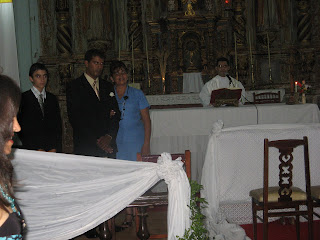
The church was a beautiful church and it was a traditional catholic ceremony with prayers, songs, exchanging of rings and vows, and communion. Instead of a bridal party there are children that assist in carrying the train down the aisle. The parents of the "novios" sit in front during the ceremony.


Afterwards we boarded the bus again. The ride back was full of giggles for myself, my host sister, her friend, and my host mom. There was Paraguayan dust flying around the bus and we sat up high in the back. We were covered from head to toe in red dust. My black top turned brown and my white skirt...well...it is no longer that clean white color it came with.
We arrived at the Bride's home where it was beautifully decorated with tables, chairs, and lights. We waited while friends of the family carried out coca-cola, beer, then sopa paraguaya, then the meal of grilled meat and salads with more Sopa Paraguaya.
Afterwards there was dancing, which for Paraguayans means dancing in lines across from your partner. I danced a little, since for a month the conversation surrounding the wedding was "jajerokyta" or "we are going to dance!" Then I walked with my host family back home where I crashed long after the stroke of midnight!