So I don't think I have ever taken the time to explain the Terere/Mate culture in Paraguay. Maybe briefly in a blog mixed with other information, but not separetely. The difference between Terere and Mate is that Terere is cold water and Mate is hot water. What you are drinking are plant leaves that have been dried and cured over a long period of time from the plant called ka'a or Yerba Mate. In Guarani if you want to say let's drink terere you say "jaterere" and for Mate you say "jakay'u." The word for let's get drunk is "jaka'u" and can easily sound the same, so be careful with this distinction.
When drinking Terere you have your equipo, or your equipment which includes:
1. Guampa (a cup made out of wood for mate and a cow's horn with a wooden "plug" for Terere)
2. Bombilla (a straw that has a filter at the bottom that looks similar to a tea ball.
3. Termo (a thermos. For Terere you usually use just a pitcher, but for Mate the Termo is important so that you can have hot water the whole time)
4. Yerba Mate (The Yerba goes into the Guampa with the straw. You fill the Guampa up almost all the way with the Yerba.
5. Yuyos (Herbs. Found in the garden, in the forest, around your yard, in the street. Lemongrass, or Cedron Paraguaya is one of my favorites along with Burrito and Anis seed. You put the yuyos either in the water and sometimes in the guampa.
Now that you have your equipo invite some friends and sit in a circle. Start conversing about whatever you want. The weather, your day, a good story, some new information about farming. One person is the server. They pour the water into the Guampa and pass it to a person in the circle. That person will drink all the water in the guampa before passing it back to the server. The server will then continue serving all around the circle and will develop an order in the serving. When you no longer want to drink anymore it is polite to say "gracias" or "Thank you" so that the server knows.
Its a beautiful custom that has a lot of ceremony to it, but is surprisingly simple.
Sunday, August 7, 2011

A Subtropical Rainforest Winter...explained
Do you know that a large majority of Paraguay was or is a subtropical rainforest and that it is the only subtropical rainforest in the world? It is fun to be able to say that I live in a rainforest and I love the vegetation that is here as a result of the climate. The trees are so different than the trees that I grew up in my frozen tundra of Minnesota. The weather in Paraguay is usually hot. In the summer it reaches 100 degrees F almost everyday. Starting in May we began to experience "Winter" weather.
Coming from the Minnesota cold that I know, I wasn't sure what to expect. They said that it would get down to 32 degrees F, or 0 degrees C occasionally during the winter. So yes, winter in Paraguay is cold. It is at its worst in the mornings, in the evenings, or when its cloudy and rainy. If there aren't any clouds and the sun comes out during the day it will warm up and I can sit in the sun and drink Terere with my neighbors. If its cloudy and rainy the day is miserable and I usually spend my day sipping hot mate and cooking banana breads or, my new favorite, Mexican Lasagna in my house. But then there are weeks where its as if we have an "Indian Summer." It gets hot again. Reaching back into the 90's. I stay cool in the shade sipping ice cold terere and aprovechar the nice weather by working in my garden, washing my clothes, or getting out and visiting a friend I haven't seen in a long time because its been so cold. I still haven't bought a fan for my house so these Indian Summers really kill me. I am waiting until it is more consistently warm and I have the money to purchase one. I know it will be necessary when the heat picks up again. For now I enjoy the cold on the good days, and dread the cold on the bad days. Its a love
hate relationship and it makes me miss those hearty Minnesota winters where on the coldest days you run between the car and the house and then sit in front of the fireplace until you thaw out. Unfortunately my house doesn't have any insulation against the weather so this makes the winters harder.
I recently tried to explain "winter sports" to my host brother and that when it snows it makes winter fun. You can go sledding, skiing, snowboarding, ice skating, play a good game of hockey, make a snow man, throw snowballs at your neighbor. Unfortunately there is no snow, so I put up with the cold weather and make winter enjoyable by cooking and drinking yummy mate!
Coming from the Minnesota cold that I know, I wasn't sure what to expect. They said that it would get down to 32 degrees F, or 0 degrees C occasionally during the winter. So yes, winter in Paraguay is cold. It is at its worst in the mornings, in the evenings, or when its cloudy and rainy. If there aren't any clouds and the sun comes out during the day it will warm up and I can sit in the sun and drink Terere with my neighbors. If its cloudy and rainy the day is miserable and I usually spend my day sipping hot mate and cooking banana breads or, my new favorite, Mexican Lasagna in my house. But then there are weeks where its as if we have an "Indian Summer." It gets hot again. Reaching back into the 90's. I stay cool in the shade sipping ice cold terere and aprovechar the nice weather by working in my garden, washing my clothes, or getting out and visiting a friend I haven't seen in a long time because its been so cold. I still haven't bought a fan for my house so these Indian Summers really kill me. I am waiting until it is more consistently warm and I have the money to purchase one. I know it will be necessary when the heat picks up again. For now I enjoy the cold on the good days, and dread the cold on the bad days. Its a love
hate relationship and it makes me miss those hearty Minnesota winters where on the coldest days you run between the car and the house and then sit in front of the fireplace until you thaw out. Unfortunately my house doesn't have any insulation against the weather so this makes the winters harder.
I recently tried to explain "winter sports" to my host brother and that when it snows it makes winter fun. You can go sledding, skiing, snowboarding, ice skating, play a good game of hockey, make a snow man, throw snowballs at your neighbor. Unfortunately there is no snow, so I put up with the cold weather and make winter enjoyable by cooking and drinking yummy mate!
Thursday, July 14, 2011
Catching you up
It has been a busy few months and I haven´t gotten a chance to blog. I recently wrote an update to friends and family that I am pasting here to catch you up on life in Paraguay!
Dear Family and Friends,
Another 3 months of this adventure in Paraguay have passed, which means it is time to write you another update. I am at the point where instead of being able to rattle off the top of my head how long I have been here I have to count on my fingers the months since I swore in or since arrived in Paraguay: 9.5 months in Paraguay and 7 months as a volunteer. While I can’t believe how fast my service seems to be flying by, everyday has a sense of lagging to it as I wake up each morning and decide how to spend those 24 hours. I think that is one of the challenges, or joys, of a Peace Corps volunteer. It is almost necessary to be intentional about everything that you do in a day, otherwise it may go to a waste, but then there are others days when things seem to happen so naturally. I feel as if these last three months have been a huge transitioning point in my integration into my community and this life feels more natural to me.
At the beginning of April my house still wasn’t finished and I was still living in a room next to teenage boys, which was a huge challenge, to say the least. I visited a fellow volunteer for a couple of days and helped her make a world map at her school. This is a fun Peace Corps project to do with schools to help them learn geography and it turns out looking beautiful. I then got encouraged to start working in my school. I helped with the planning and planting of the school garden by giving informational talks about nutritional gardening. The fruits of our work are paying off and in a couple of weeks I hope to return to give talks about nutrition. I also celebrated Tree Day on June 19th by planting saplings in May with the 7th graders, who took care of the trees, and I went weekly and did activities with them to raise awareness about reforestation. On the actual day they presented a small skit and tree proverbs, and planted their little trees around the school. Working at the school has its joys and challenges. The kids are often the joys, and learning how to manage the cultural differences between myself and the teachers are the challenges.
Holy Week was in April, which is a long vacation and family time for Paraguayans. As Holy Week (Semana Santa) approached, I spent a lot of time helping the women make Almidón. Holy Week arrived with lots of different cultural traditions. The week is spent with family, who come from all parts of Paraguay to return to visit their parents Wednesday is spent making Chipa, which will be eaten from after lunch on Thursday until Saturday afternoon. The other exciting thing about Holy Week was that I finally moved into my house, which I think has been a transitioning point in my relationships with my community. I have felt relationships become more natural and my place in my community is more of a member than an outsider.
I would characterize this May as a month of parties. If there wasn’t one party, we were preparing for another. One of the big parties of the year in my community is the Mother’s day party. The community puts on a show of traditional dances, poems and songs to mothers, modern dances, and skits. I joined in on the festivities by learning typical Paraguayan “DanzaParaguaya,”which I danced during the party and it was enjoyed by everybody. That same weekend was the bicentennial celebration to celebrate Paraguay’s 200 years of independence from the Spanish. The following weekend there was an ordination of a priest who is from my community, so the women all got together to make traditional breads and I joined in by attending the festivities. There have been six men from my community that have become priests! Also in May I gave my first “Charla” or informational talk to the women’s committee about making homemade chicken feed. While it was a fairly successful informational talk, I think that many of the agricultural goals that Peace Corps is trying to accomplish are better done by showing rather than telling. I recently submitted a grant to a local NGO on behalf of the women’s committee asking for the funds to build chicken coops and to raise layer and meat chickens. The grant includes a project of planting and then making homemade chicken feed, which I think will be a more effective strategy. Hopefully we receive the funds for this project so that we can move forward!
In June I hardly felt like I was in my community, but it was a very exciting and fulfilling month nonetheless. Why, you might ask? Volunteers are granted 2 vacation days for every month of service. We are also allowed to have visitors come to our communities. My parents decided to come for a visit, which included a week-long vacation in Argentina, a week in my community, and another few days in Asunción. Argentina was a breath of fresh air for me. Buenos Aires is a very modern city and it was fun to walk around and take in the fun architecture. Some fun things we saw and did were going to Eva Peron’s museum and seeing where she was buried, going to the Plaza de Mayo, where she gave some famous speeches and where there is a weekly demonstration by the “Mothers of the disappeared.” We also went to a tango show! We got outside of Buenos Aires on our way back to Paraguay and visited Jesuit Ruins and the famous Iguazu Falls. I returned back to my community with my parents and we had a good week helping me continuing to get settled in my house, cooking together, visiting different community members, and celebrating my birthday with a big community celebration where I surprised my parents with more “DanzaParaguaya.” We spent the last 3 days in Asunción relaxing and seeing what there is to see. I had a great three weeks with my parents and learned more about the region and community I am serving in in the process. I also felt very blessed as I listened to my community members relate to my parents how much they love me and that they are looking out for me. Being able to see the development from where I was six months ago until now is a testimony to the time that I have put into these relationships as well as the God’s work in my life and in this community.
The week after my parents returned to the states there was an in-service training with a contact from my community at an Agriculture High School that is practicing sustainable agriculture. My contact, Antonia really enjoyed it and is excited to try some of the things we learned about here in the community. I am excited as well. We recently plantedLupino, a green manure, in herMandioca field and she just put a mulch layer on her garden!
Every day is a new adventure here in Paraguay as I learn new things about the culture around me. I will often ask Estela, my host mom here, or another friend why something is the way it is and then afterwards I will say, “ahoraentiendomás” or, “now I understand more.” I think this occurs at least once daily. I will continue to learn over this next year and a half and try to communicate as best I can with you about this country and culture so that you also can “entendermás.” So what’s coming up? If the women’s committee receives the grant money my life will become a lot more busy building chicken coops, planting crops, teaching the women how to care for chickens, and working on reforestation projects. From August 25th until September 12th I will be in the United States celebrating the marriage of my good friend, mourning the loss of a dear uncle, celebrating the upcoming birth of a nephew, and visiting friends and family! Thank you for your thoughts, supports, and prayers. You are in mine as well. I enjoy keeping in touch!
Blessings,
Madeleine

Iguazu Falls, Argentina. “Iguazu” in Guarani means, ”huge water”

Dancing at the Mother’s day party

My House!

The Seventh Graders with one of their trees!

Making Chipa with Estela and her mother

Jack Bean (Canavalia), a green manure, intercropped with my corn
Sunday, April 24, 2011
Mass Chipa making...as promised
Well...Chipa season has arrived. I am sick of chipa, that's for sure. Not just in my tast buds either, it has definately affected my digestive system. Here is how my Easter week (Semana Santa) has broken down: Sunday I went to mass with my host family and had Terere and lunch with my neighbors. Monday and Tuesday were "business as usual" (whatever that means)Monday I gave Charlas at the School about companion planting and helped them plant the garden and on the way home drank some delicious Passion Fruit juice (homemade) at a friend's house. Tuesday my house was ready so I bought a bed, cleaned the floors and moved in! I also dropped in and watch some of the women make Chipa. They were getting an early start.
Wednesday is the Chipa day. I went over to my host grandma's house because my mom doesn't have a tatakua(clay dome oven) and made chipa all day long. Thursday I helped Estela (host mom) make Sopa Paraguay for our Cena final (final meal), which was Asado, Sopa Paraguaya, and Mandioca. Then Estela and I drank wine and coke and talked for a while and then I went to a nemboe hape (prayer meeting) because someone in the community had recently died. From Thursday afternoon until Saturday morning no work is supposed to happen...actually until sunday as well. Friday I went back to the same friend's house who gave me Passion Fruit juice and hung out with her family and her sister-in-law's family. She gave me some chipa. Her house is pretty far away and down this huge hill in my community but luckily another friend passed with her family in their newish truck and I hitched a ride up the hill. We drank Terere and she gave me my own back of Chipa.
It seems to be a custom for everyone to give the Norteamericana her own bag of Chipa. I have a huge pile of it in my house now.
Friday afternoon the community met on one edge of the community and we walked house to house praying and reading each station of the cross. It was finished by saying the Apostle's creed at the Prayer Chapel. Saturday, Yesterday, rained all day and I stayed in my house with Ara, my cat, and read, and wrote letters, and did some more unpacking. That was my Semana Santa. I tried to go into Asuncion early this morning for an English Speaking service that I had heard about, but it never happened. It is kind of weird to not have all the Easter traditions that I am used to, but I appreciated walking the stations of the cross on Friday.
So...here are the Chipa pics:
 Estela Mixing the Lard and the Eggs
 Adding the Almidon/Corn Flour


 Forming the Chipa

 Taking the Chipa out of the Tatakua
 A family event. All the women making chipa
Wednesday is the Chipa day. I went over to my host grandma's house because my mom doesn't have a tatakua(clay dome oven) and made chipa all day long. Thursday I helped Estela (host mom) make Sopa Paraguay for our Cena final (final meal), which was Asado, Sopa Paraguaya, and Mandioca. Then Estela and I drank wine and coke and talked for a while and then I went to a nemboe hape (prayer meeting) because someone in the community had recently died. From Thursday afternoon until Saturday morning no work is supposed to happen...actually until sunday as well. Friday I went back to the same friend's house who gave me Passion Fruit juice and hung out with her family and her sister-in-law's family. She gave me some chipa. Her house is pretty far away and down this huge hill in my community but luckily another friend passed with her family in their newish truck and I hitched a ride up the hill. We drank Terere and she gave me my own back of Chipa.
It seems to be a custom for everyone to give the Norteamericana her own bag of Chipa. I have a huge pile of it in my house now.
Friday afternoon the community met on one edge of the community and we walked house to house praying and reading each station of the cross. It was finished by saying the Apostle's creed at the Prayer Chapel. Saturday, Yesterday, rained all day and I stayed in my house with Ara, my cat, and read, and wrote letters, and did some more unpacking. That was my Semana Santa. I tried to go into Asuncion early this morning for an English Speaking service that I had heard about, but it never happened. It is kind of weird to not have all the Easter traditions that I am used to, but I appreciated walking the stations of the cross on Friday.
So...here are the Chipa pics:
 Estela Mixing the Lard and the Eggs
 Adding the Almidon/Corn Flour

 Forming the Chipa
 Taking the Chipa out of the Tatakua
 A family event. All the women making chipa
The recipe for Chipa goes like this:
Lard
Almidon Flour
Corn Flour
Eggs
Anise
Whey
Can you handle it? Chipa, Chipa un Mil!
Mi oga'i (my little house)
The months of March and April have been rather busy for me, but not necessarily planting green manures with farmers or giving presentations about how to care for your chickens. I have been devoting a lot of time to building my house. My community has about 35 houses in it overall. All but 3 were occupied when I arrived in the community. Two out of 3 are extremely isolated and were not in the best interest of my safety. The third was filled with termites (kupi'i in Guarani) and I refused to try and use the "remedio" to get rid of them...let's face it, there are a lot of trees around and I didn't want to fight with kupi'i for two years.
Another option was renting a room with a family. Most families have children that come from Asuncion to visit every once and a while so renting a room from them was not an option. My last option was to live in a house that the previous volunteer built, but he gave it to the family, who then added onto it and used it for their teenage sons. Lets face it...female introverted American, sharing a space with 15 and 16 year old Paraguayan boys who love motorcycles and loud reggaeton music at all hours of the day (an night), and morning....
So I decided to build a small room on the property of my community contact. Her husband works construction so he helped design it and we build it together. He recommended using bricks, since wood is expensive and there is not longer straw around for roofs. The house is on the back edge of their property right before the soccer field/cow pasture. After the cow pasture becomes the fields. Don Ramon, my contact's husband, is extremely worried about my safety and since I am so close to the Chacra I am more at risk. I like the location. It is really tranquilo. I don't have to fight with reggaeton as much, and I am off the main road. When neighbors come over, which they do since my contact is an unofficial community leader, I can wave and say hello from my door.
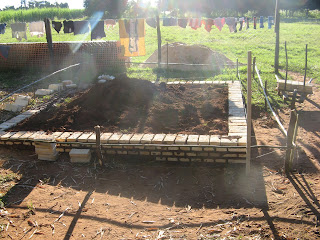 building the foundation.
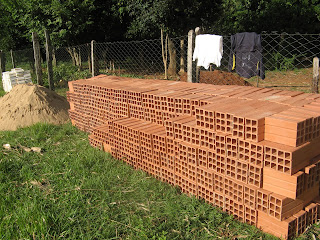 My materials. Bricks, sand, and more bricks.
 building the walls.
 Super Guapo (hard-working) Don Ramon Varela building the house up.
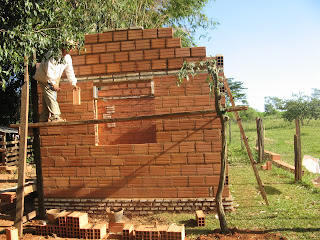 Paraguayan equivalent of scaffolding.
 Framing the roof. Not the same as in the states.
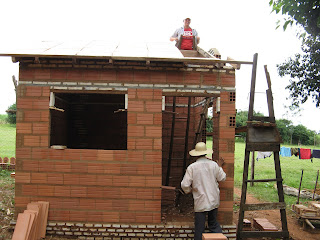 Sticking my little head through the roof on the day we put on the Tefuelon (an insulation layer on the roof)
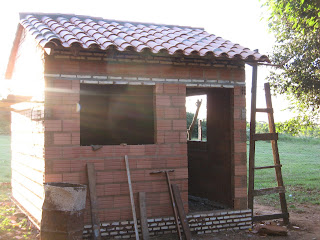 Oimpama la oga. (The house is finished!)
Another option was renting a room with a family. Most families have children that come from Asuncion to visit every once and a while so renting a room from them was not an option. My last option was to live in a house that the previous volunteer built, but he gave it to the family, who then added onto it and used it for their teenage sons. Lets face it...female introverted American, sharing a space with 15 and 16 year old Paraguayan boys who love motorcycles and loud reggaeton music at all hours of the day (an night), and morning....
So I decided to build a small room on the property of my community contact. Her husband works construction so he helped design it and we build it together. He recommended using bricks, since wood is expensive and there is not longer straw around for roofs. The house is on the back edge of their property right before the soccer field/cow pasture. After the cow pasture becomes the fields. Don Ramon, my contact's husband, is extremely worried about my safety and since I am so close to the Chacra I am more at risk. I like the location. It is really tranquilo. I don't have to fight with reggaeton as much, and I am off the main road. When neighbors come over, which they do since my contact is an unofficial community leader, I can wave and say hello from my door.
 building the foundation.
 My materials. Bricks, sand, and more bricks.
 building the walls.
 Super Guapo (hard-working) Don Ramon Varela building the house up.
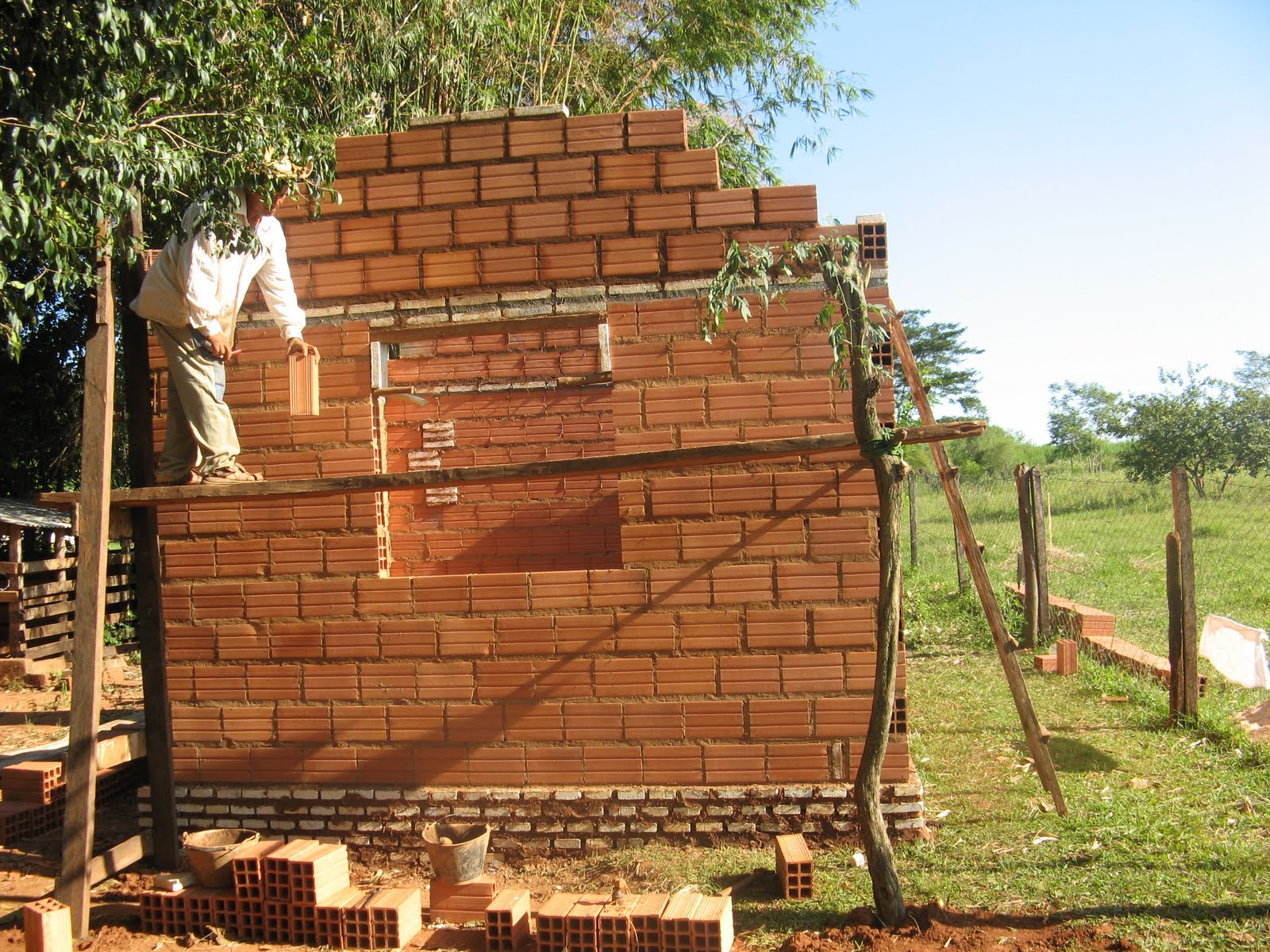 Paraguayan equivalent of scaffolding.
 Framing the roof. Not the same as in the states.
 Sticking my little head through the roof on the day we put on the Tefuelon (an insulation layer on the roof)
 Oimpama la oga. (The house is finished!)
From the first picture in the series until the last it maybe took two and a half weeks, but I then spent the next month waiting for the doors and electricity to be installed.
Building a house with a Paraguayan man was an interesting experience. My training in SOS along with some church missions trips gave me some of the skills I needed, but I still am not well versed in technical construction language in Spanish, or in the techniques of building a house out of bricks. That, and the fact that I am a woman working in a culture that values Machismo, created their frustrations, but in the end the house is finally constructed and I have slept there for a total of 5 nights. I don't have the most recent pictures. Since these pictures were taken we have put in windows and doors and electricity. We also built pillars that will become my porch so that I can sit outside and read, drink Mate in the rain while drying my clothes, or hanging my herbs to dry.
Tuesday, March 8, 2011
Nuestro Pan de Cada dia
Paraguayan Bread = well, the way that I think about bread I would say that bread doesn't exist in Paraguay. Of course it does, but not in that fresh, whole wheat grains, out of the oven kind of way. Instead Paraguayans have "Sopa Paraguaya," "Chipa," and "Chipa Guasu." Sopa Paraguaya and Chipa Guasu are sort of like corn bread that are made with different classes of corn flour, with sometimes mixing in wheat flour, or "harina comun." Chipa, on the other hand, is made with Mandioca flour. I love Chipa. It is sold on the buses into Asuncion. The time of the year that it is eaten the most is during holy week, and the women in my community have started to prepare to make their chipa. My host mom is saving her milk to make cheese, my neighbor is buying firewood to make the chip in her "tatakua" or brick oven, another neighbor bought the fat that is in the chipa, and the women's comite have been makin the Mandioca Flour, called Almidon.
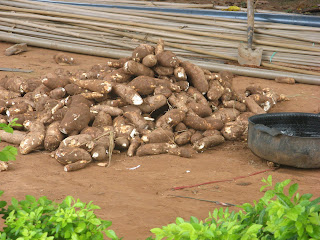 This leaves a pile of mandioca sitting on the lawn that was usually transported on an ox cart.
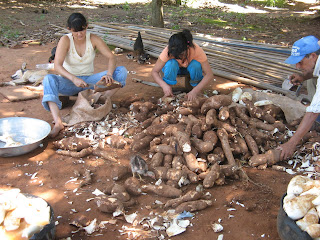 After 5 times of making almidon I think that I am finally getting the hang of peeling mandioca. I first tried to peel it like a potato, but there is actually a thick layer of skin that you need to get off. I am really proud that I have accomplished this.
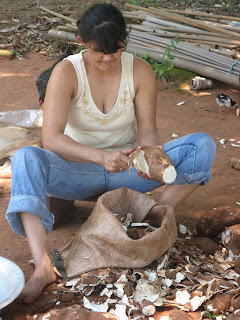 My host mom Estela is really bombin' at this.

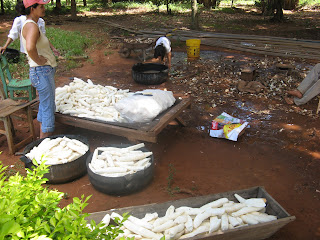 Pretty straight forward: Scrub scrub scrub
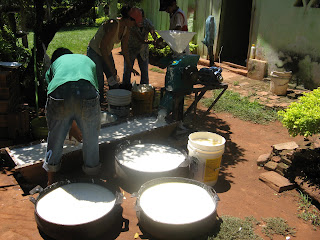
Makin Almidon is a HUGE project that can take up to days. Luckily the women were able to acquire the money to buy a grinder so now it takes less days.
Step One: Harvest the Mandioca. 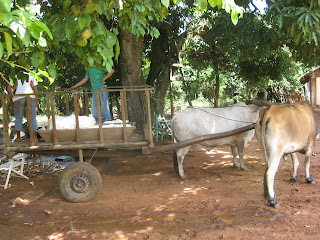
This leaves a pile of mandioca sitting on the lawn that was usually transported on an ox cart.Step Two: Peel the Mandioca.
After 5 times of making almidon I think that I am finally getting the hang of peeling mandioca. I first tried to peel it like a potato, but there is actually a thick layer of skin that you need to get off. I am really proud that I have accomplished this.My host mom Estela is really bombin' at this.Step Three: Wash the Mandioca
Pretty straight forward: Scrub scrub scrubStep Four: Grind the Mandioca
Step Five: Wash the mandioca and separate the "Flour" part from the other part. I really don't know what this is called, and I think this is more like a few steps thrown into one, because I don't understand the purpose of it all. The women stand over baskets with feed bags that the ground mandioca that has been mixed with "leche" (or water mixed with some of the almidon) is poured into. Then there are a couple of more scoops of the leche that goes into it and then a couple of scoops of water that you pour over it and then squeeze the water and "leche" out. 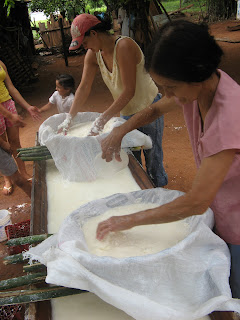
Step six: let the leche and almidon mixture sit for 3 hours.
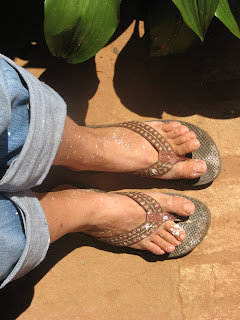 My Feet after a long day of helping the women make Almidon.
So I have yet to see this mass making of chipa. More on chipa making to come....
Step seven: Pour the water out of the tubs and scrape the almidon from the bottom.
Step eight: Dry the almidon on a warm sunny day.
Step nine: enjoy!
My Feet after a long day of helping the women make Almidon. So I have yet to see this mass making of chipa. More on chipa making to come....
Thursday, February 24, 2011
An Inauguratory Ride
The 3:00 sun was beating down on the earth with such strength that it pierced my skin to the bone. The day before I had promised Na Adria that I would visit her. I had yet to visit her since she lives back in the fields behind the trees and I only recently knew her home existed. I didn't know exactly where it was so I asked my 9 year old host brother, Gustavo, to accompany me. The day before my bike had arrives and I was anxious to take it for a spin.
So with the power of the sun piercing our skin we set out on our journey, he on foot, and I on my new bike. It was a release to be able to zip through the Kokue (fields) after 2 months of going everywhere on foot. But the caminoe (path) is not as smooth as it used to be. The grass has been padded down and browned by traffic. The soil is exposed and when it rains the dirt is washed away. The motos and oxen carts beat it down and it has become uneven. I had to stop myself several times so I wouldn't fall. I heard Gustavo running behind me as I struggled over the rough terrain.
We passed the mandioca field and my small demo plot where my corn and beans are growing well. We passed a Senor's field of corn that I had watched go from being disced to my height in a short time. We passed sugar cane that is starting to reach harvestable height. When we reached some trees I decided we needed a rest. I was glad I had filled the water bottle (came new with the bike!) with water.
I climbed back on the bike and we continued. When we reached part of the ride along a barbed wire fence that is cow pasture I decided to walk to prevent falling and cutting myself on the wire! Gustavo, like a good Paraguayan "man" offered to walk the bike. He had told me a couple of days before my bike arrived that he would use it to go to school, so I told him to hop on and try it out. He did, and his short legs barely reached the pedals, and he was sitting on the bar instead of the seat. He continued to ride on the smooth road we had entered. As much as I wished to be the one to initiate my bike, I allowed him to continue. The sun had worn me out and there was no shade on the road, so I made the call to enter into Grandma's house for a rest. She welcomed us in, even though she was bathing her children, and we refilled our water supply with cold water.
We entered the Kokue again. Gustavo rode and I followed until we reached Na Adria's house. She invited us in for Terere and she and I chatted about her life, her children, and her crops while Gustavo rode back to get something from Grandma.
After a while it was looking like the visit was coming to a close (the pitcher of water was empty and the Yerba had lost its flavor.).
I hopped on the bike and Gustavo followed, but this time our hands were full. Gustavo carried a bag of things from Grandma and the winter squash Na Adria had given us. I carried a bag of Peanuts that she had also given to us.
The path was smoother and I was starting to get the hang of it, but Gustavo was falling behind, so I offered to let him ride for a while. When we reached the big hill, that I call the Montana (mountain), Gustavo kept trekking on up until we reached the top and I asked to switch. I wanted to finish the inauguratory ride I had started. The journey was all down hill and Gustavo was carrying our winter squash so he was left in my dust, litterally. After I arrived home and dropped our peanuts off, I turned around and met him on his journey. I sent him off on the bike and caried his things the rest of the way. We were each a part of the end of the bike's first journey through tercera calle! Gustavo followed me into my room to put the bike to rest until our next journey!
So with the power of the sun piercing our skin we set out on our journey, he on foot, and I on my new bike. It was a release to be able to zip through the Kokue (fields) after 2 months of going everywhere on foot. But the caminoe (path) is not as smooth as it used to be. The grass has been padded down and browned by traffic. The soil is exposed and when it rains the dirt is washed away. The motos and oxen carts beat it down and it has become uneven. I had to stop myself several times so I wouldn't fall. I heard Gustavo running behind me as I struggled over the rough terrain.
We passed the mandioca field and my small demo plot where my corn and beans are growing well. We passed a Senor's field of corn that I had watched go from being disced to my height in a short time. We passed sugar cane that is starting to reach harvestable height. When we reached some trees I decided we needed a rest. I was glad I had filled the water bottle (came new with the bike!) with water.
I climbed back on the bike and we continued. When we reached part of the ride along a barbed wire fence that is cow pasture I decided to walk to prevent falling and cutting myself on the wire! Gustavo, like a good Paraguayan "man" offered to walk the bike. He had told me a couple of days before my bike arrived that he would use it to go to school, so I told him to hop on and try it out. He did, and his short legs barely reached the pedals, and he was sitting on the bar instead of the seat. He continued to ride on the smooth road we had entered. As much as I wished to be the one to initiate my bike, I allowed him to continue. The sun had worn me out and there was no shade on the road, so I made the call to enter into Grandma's house for a rest. She welcomed us in, even though she was bathing her children, and we refilled our water supply with cold water.
We entered the Kokue again. Gustavo rode and I followed until we reached Na Adria's house. She invited us in for Terere and she and I chatted about her life, her children, and her crops while Gustavo rode back to get something from Grandma.
After a while it was looking like the visit was coming to a close (the pitcher of water was empty and the Yerba had lost its flavor.).
I hopped on the bike and Gustavo followed, but this time our hands were full. Gustavo carried a bag of things from Grandma and the winter squash Na Adria had given us. I carried a bag of Peanuts that she had also given to us.
The path was smoother and I was starting to get the hang of it, but Gustavo was falling behind, so I offered to let him ride for a while. When we reached the big hill, that I call the Montana (mountain), Gustavo kept trekking on up until we reached the top and I asked to switch. I wanted to finish the inauguratory ride I had started. The journey was all down hill and Gustavo was carrying our winter squash so he was left in my dust, litterally. After I arrived home and dropped our peanuts off, I turned around and met him on his journey. I sent him off on the bike and caried his things the rest of the way. We were each a part of the end of the bike's first journey through tercera calle! Gustavo followed me into my room to put the bike to rest until our next journey!
Subscribe to:
Posts (Atom)